History of the Center for Legal Medicine
The current Center for Forensic Medicine is the heir to the traditions of the first institution that grant the forensic services on the territory of the SSM, called the Republican Office of Medical-Legal Expertise (BEML), created on October 1, 1951 by the Order of the Council of Ministers of the SSM. The office and the Republican expertise and city expertise from Chisinau, Balti, Bender, Tiraspol, Soroca, Cahul and Orhei were included in the office composition of the office; The medical-legal laboratory with 3 subsections was organized: biological investigations, judicial chemistry and histopathology. The status of the office to that time constituted 55 units, and the headquarters was located on Pavlov street, 2, or. Chisinau.
Between 1958-1987 new medical-legal sections were opened in the territory; The Methodical Council was organized from the composition of which the leaders of the sections within the BEML and some collaborators of the Department of Legal Medicine. In 1962, for the first time in the SSM, the "Regulation of appreciation of the degree of severity of the bodily lesions" was approved. During this period, the office changed its headquarters, being in 1970-1986 on Belinski street, 4, or. Chisinau, later being transferred to the current building of the Center for Forensic Medicine on Korolenko street, 8, Chisinau municipality. By 1985 Beml already had 259 employees, including 91 experts.
By the Order of the Ministry of Health of the Republic of Moldova no. 219 of 7.10.1996 The Republican Office of Medico-Legal expertise has been reorganized in the Center for Legal Medicine. By Order MS no. 239 of 10.10.1997 was approved the first regulation of the Center for Legal Medicine as a specialized medical-scientific institution financed by the state, which coordinates the activity of all the forensic sections in the Republic and is the clinical basis of the USMF "Nicolae Testemitanu". By organizing the CML, changes were introduced in directing the activity of the forensic service, the employee service obligations were established.
In 2009, the center signed a bilateral collaboration agreement with the State Service of Medical-Legal Expertise in the Republic of Belarus, based on which the specialists from the Republic of Moldova perfected their professional knowledge in various forensic fields (Tanatology, histology toxicology, biology, genetics) both in Belarus and at work. The managerial activity was directed to attract the financing projects; Actions were taken to strengthen the forensic examination of torture cases and other forms of mistreatment. ÎÎn perioada 2015–2020 serviciul de medicina legală a avut următoarele realizări: acreditarea Centrului de Medicină Legală de către Consiliului Naţional de Evaluare şi Acreditare în Sănătate (2016); implementation of corporate public symbols; the conclusion of the bilateral collaboration agreements with the Institute of Forensic Medicine in Iași and the Office of Medical-Legal expertise in Odessa; the transmission to the center of the forensic psychiatry service starting April 1, 2017; Implementation of the provisions of Law 68/2016 regarding the judicial expertise and the status of the judicial expert; Within the forensic biology section, the molecular-genetic investigation laboratory was founded. Starting with 2020 the activity of the Center for Legal Medicine has been fortified by the following actions and achievements: certification according to the international standard ISO 9001: 2015 (2021); accreditation of the Medical-Legal Toxicology Section according to the International standard ISO 17025: 2018 (2023); approval of the medium -term development strategy; approval of the annual activity plans; Efficiency of the management of the forensic examination of the deceased persons.
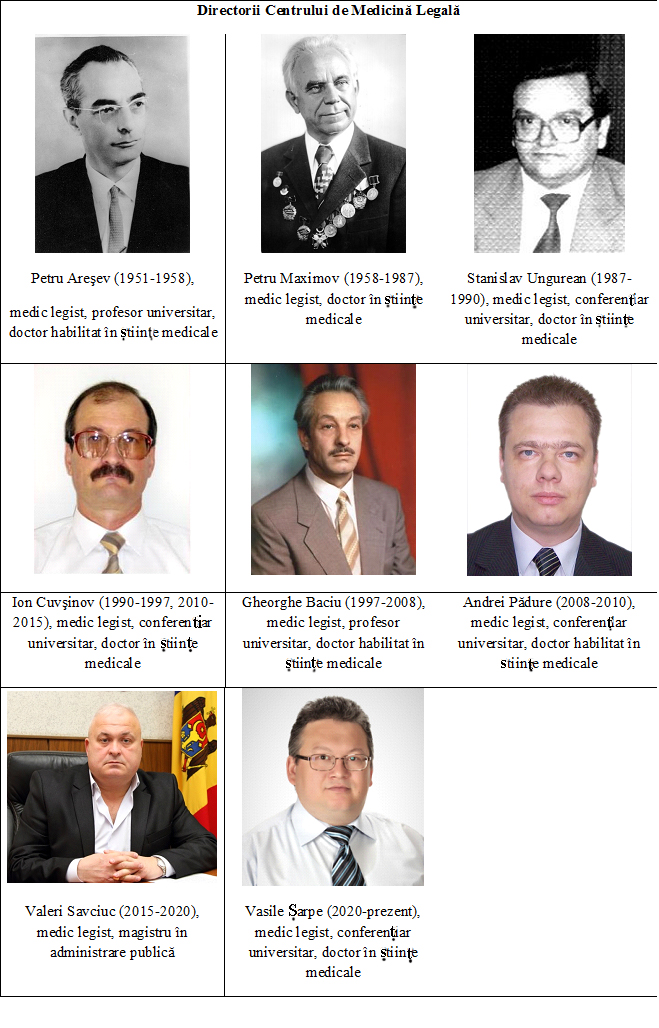
The leaders: